
I couldn’t wait to see my 5th world wonder – Treasury of Petra. It took as around 3 hours to get to Petra from Madaba. Probably it is about the same distance from the Amman Airport too.
Table of Contents
We passed by a lot of plain fields and some of those fields hosted a lot of rubbish, but I’ll write about that in a separate post.


All we had was road ahead and much clearer and blue sky.

I was very happy after 3 hours to see a sign of Petra.

Mousa’s Spring
Finally, we were close to Petra and we stopped at Mousa’s Spring, which was free of charge.

The area around Petra, though arid, is not devoid of water sources. One such significant location is Mousa’s Spring (or “Ain Musa”), which holds historical and possibly religious importance. The name “Mousa” is associated with the prophet Moses, and local traditions link this spring to the biblical story of Moses striking a rock to bring forth water.
While the exact historical accuracy of these connections is debated, the presence of a reliable water source in this desert environment would have been crucial for ancient inhabitants, including the Nabataeans who built Petra.


We booked Petra Icon Hotel for two nights, which was a 3 star hotel. However, few days before the date we received a message saying that due to the conflict they cannot host us in the Petra Icon Hotel and instead we will get an upgrade to 4 start Petra Moon Hotel (their sister company). We were happy!

The hotel was really outstanding by the service, room and restaurant in the hotel.
Petra Treasury
We just dropped our suitcases and were heading to Petra Visitor Centre to exchange our Jordan Pass to an actual ticket. It was very quick (less than couple minutes) as there was no queue at all and it was only four of us. Then at the same time we booked the Petra at Night tickets for 17 JOD each. That took slightly longer (like 5 minutes) to sort out. We were lucky that it was Monday and they have shows on Monday, Wednesday and Thursday.
Just at the start of the road to Petra some local were asking if we want a horse and said it is included in the ticket. We politely refused and said something that we don’t want to torture the horses, which was in context that basically it is an animal abuse. After that comment they got really aggressive and shouted at us as we were walking away. In one of the websites it says just treat as it is not included, as they would aggressively demand for big tips afterwards and the ride back you would have to pay them fully as that’s not included, so best just to avoid them, which we did.
Djinn blocks or God blocks
As you wander through the ancient city of Petra, your gaze will likely be drawn to the intriguing, free-standing, cube-shaped monuments that dot the landscape. These are the Djinn Blocks, silent witnesses to the rich history and fascinating beliefs of Petra’s long-vanished inhabitants. These monuments are also sometimes referred to as ‘god blocks’ because Nabataean (an ancient Arab people who formed a powerful kingdom in northern Arabia and the southern Levant, centred around the city of Petra) gods were represented as stone blocks.
Carved into existence between 50 BC and 50 AD, these structures have long puzzled those who have come across them. The name “Djinn” itself offers a clue to their story. In Arab folklore, Djinn are supernatural spirits, and the Bedouin people who once called Petra home believed these blocks were habitations for these entities.
While the spirit world may have held sway in the past, modern archaeological understanding leans towards a more grounded explanation. Today, these Djinn Blocks are generally accepted to have been tombs or memorials, erected to honor and commemorate the departed.
A prominent group of Djinn Blocks can be found at the very entrance to Petra, in the area known as Bab el-Siq. But these are not the only examples; around 25 of these enigmatic structures are scattered throughout Petra.
The early archaeologists who explored Petra meticulously cataloged its many tombs, assigning a number to each one – a system that continues to be used by researchers today. The Djinn Blocks at the entrance, for instance, are marked as numbers 7, 8, and 9 on archaeological maps of the site, linking them to this historical record of discovery.


Another Djinn block is just next to the canal tunnel.

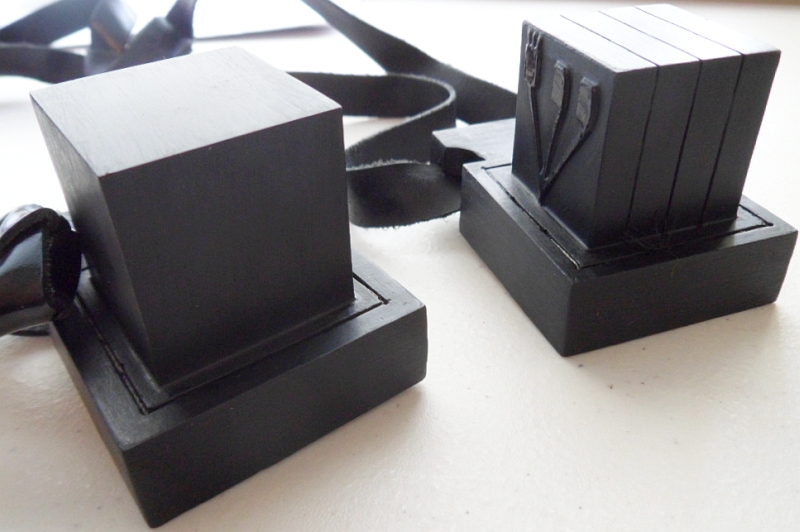
Also, another interesting fact that these Djinn or God blocks very much resemble tefillin (also known as phylacteries). Tefillin are small black leather boxes containing parchment scrolls with verses from the Torah. Jewish men wear one box on their head and the other on their upper arm during weekday morning prayers. The square shape is linked to the idea of making our bodies a dwelling for God, similar to the Holy Temple and the letter “mem” which is also square. Archaeological evidence suggests a form similar to modern tefillin existed by the late Second Temple period, around the end of the 2nd century BCE, which is a century and a half before these Djinn blocks were carved. Did Judaeans’, who were living in the same region just around 300km away, influence these god blocks in Nabatean culture or was it just a mere coincidence? Their shape is definitely similar: a smaller cube on top of a slightly bigger rectangular base. The god block houses the deity/spirit and tefillin houses the word of god.

Obelisk Tomb & Bab as-Siq Triclinium
Among the first significant monuments you’ll encounter are the Obelisk Tomb and the Bab as-Siq Triclinium, located near the entrance of the Siq, Petra’s main access point and almost in front of Djinn blocks. These structures offer a fascinating look into Nabataean architectural styles and their elaborate customs surrounding death and commemoration.
The Obelisk Tomb is a rock-cut monument distinguished by its upper section, which features four obelisks. These obelisks are believed to be “Nefesh” symbols, representing the deceased individuals buried within. The tomb’s design reflects a blend of architectural influences, including Egyptian elements, most notably seen in the obelisks, along with Hellenistic and Nabataean styles. This fusion of styles is a testament to the Nabataeans’ ability to incorporate and adapt various cultural influences into their own unique architectural expressions.
Located below the Obelisk Tomb is the Bab as-Siq Triclinium. The term “triclinium” refers to a dining room, and this structure served as a hall for funerary banquets. These banquets were important Nabataean rituals held in honor of the dead, providing a space for family and friends to gather, remember, and pay their respects. The presence of this triclinium alongside the Obelisk Tomb highlights the significance of communal remembrance in Nabataean society.

The Siq: Entrance to Petra’s Treasury
The main entrance to the ancient city of Petra, which is natural sandstone gorge, known as the Siq, winds for nearly 2km towards the ancient city of Petra, culminating in the breathtaking view of the Treasury. The Siq’s entrance was once adorned with a triumphal arch, which collapsed in 1895.
The word “Siq” simply means “shaft” in Arabic, which gives you a hint of what to expect: a narrow passage that winds its way through the rock.

Before entering Siq you will cross the bridge and will notice the incline going down once you enter the Siq, which otherwise would get flooded easily during flash floods and if you are “lucky” enough (as it is quite rare) to see water flowing in the Siq you should immediately evacuate or climb to higher ground. Also, you can see one of the Djinn Blocks next to the entrance ( you can see it in the centre of the picture in the distance).

During heavy rains, flash floods from a large catchment area east of Petra would surge through Wadi Musa and into Bab as-Siq, damaging the city. A major flood around the mid-1st century BC destroyed the early water pipeline, road, and buildings. Subsequently, the Nabataeans built a complex flood protection system.
In the 1st century BC, to control floodwaters, a dam was built across the mouth of the Siq, along with basins to hold water and an 82-meter long rock-cut tunnel. This tunnel redirected water through Wadi Mudhlim to reservoirs, water cisterns and dams inside and outside Petra. The dam you see today was constructed in 1964 over the original, larger Nabataean one, to prevent a recurrence of a tragic flash flood that had earlier swept through the Siq. Towards the end of Wadi Mudhlim, niches likely held baetyls, or god blocks, to protect the water, which was sacred to the Nabataeans.
The Wadi Muthlim Tunnel was cleared in 2000, allowing unimpeded water flow. Tours through this tunnel are hazardous and require a local guide, so don’t attempt it on your own. At least three people died in 2021 when floodwaters swept away their car, while more than 30 people were killed in flash flooding that hit Petra and Jordan’s Dead Sea coast in two separate floods in 2018. In 2025 flood only 2 people died due to the flooding (not in Petra).
Intricate Water Channels
The Siq isn’t just a natural wonder; it’s also a testament to the engineering skills of the Nabataeans, the people who built Petra. This narrow natural passage was the main caravan route into the city, and its very design offered a natural defence against invaders. As you walk, keep an eye out for the remarkable remnants of Nabataean engineering, like the water channels carved into the side of walls, dams and the ancient paving stones under your feet (a small section closer to Treasury).
The Nabataeans, the ingenious people who built the ancient city of Petra, were masters of water management. Their very survival and the city’s prosperity in such an arid environment hinged on their ability to efficiently harvest, store, and distribute water. A cornerstone of their system was a complex network of terracotta pipes that criss-crossed Petra.

These pipes were ingeniously designed with tapered ends for a snug fit – a feature only recently rediscovered by modern engineers. Laid at precise angles of around 2 to 4 degrees, they ensured a steady flow of water, showcasing the Nabataeans’ advanced understanding of hydraulics. Too steep would have caused the pipes to burst from the pressure, too flat and the water flow would be insufficient. This extensive network of pipelines, stretching over 200 kilometers, was integrated with other water management structures like cisterns, dams (which I will discuss below, and channels, serving a multitude of purposes from providing clean water for domestic use and supporting agriculture to ensuring a reliable supply for trade caravans.


If you look closely, you will notice chisel marks while walking the down the Siq , where the water channel was carved as well as in some places the remains of terracotta pipes.

Ingenious dams
The Nabataeans, who thrived in the arid landscape of Petra, were highly skilled in water management as we can see from the network of water channels they built. However, their dam system was even more important to their water management ingenuity. As mentioned above, this region was prone to flash floods, Petra’s survival depended on controlling these powerful torrents. The Nabataeans engineered a sophisticated network of dams to protect the city and conserve water.
These dams, strategically positioned across the wadis (dry riverbeds) surrounding Petra, served a dual purpose. Firstly, they acted as flood control measures, diverting and slowing down the flow of water during heavy rainfall. This prevented destructive flash floods from surging through the Siq, Petra’s narrow entrance canyon, and damaging the city’s structures. Secondly, the dams helped to capture and store precious rainwater, which was then distributed throughout Petra via a network of channels, pipes, and cisterns. The dams varied in design and size, depending on their location and purpose
We’ve spotted few of the dams on the way to the Treasury in Siq.


As you walk through the Siq, you’ll be surrounded by towering sandstone cliffs, in some places reaching up to 200 meters high! These cliffs were formed by natural tectonic forces, which means the earth’s movement split the rock apart. Over millions of years, water and wind smoothed the rough edges, creating the dramatic and beautiful passage we see today.
Camel Caravan Reliefs
Pay attention to the carvings while walking in the Siq as there is one very impressive one called Camel Caravan.
In 1997, excavations in Petra’s Siq uncovered large (c. 3.5m high) relief carvings of camel caravans on the south and west walls, located at the major bend in the path. Dating to before the Siq was paved in 50 BCE, these are among Petra’s earliest sculptures.
The reliefs depict drovers in woolen trousers and sandals, each holding a stick, leading camels. The southern relief’s front drover is well-preserved, wearing a tunic/skirt with symmetrical folds. Two rock-cut cultic niches are between the approaching groups.
These reliefs, which predate the Siq’s water channel, highlight the Nabataean kingdom’s trade dependence.

There are other reliefs of camels further (closer to Treasury), but they are more faded away. Each relief shows a drover leading a camel, followed by a second drover leading a second camel. The full height of the reliefs is 3.5 m; the uphill (southern) relief is 9.5 m in length, the downhill (western) relief is 10.3 m in length.

If you walk further you will be able to see all of the three reliefs in one line, together with impressive water channels carved on both sides.

The Treasury (Al Khazna)
Walking through the Siq, adoring Nabatean engineering and the tombs on the sides of the road you build up to the grand reveal of the breathtaking Petra Treasury. First, you see just a peek through the gap of the Siq.

It took us around 40 minutes in total to get from Petra Visitor Centre to Petra Treasury with some stops to take pictures.
The name “Al-Khazna” actually means “The Treasury” in Arabic, given to it by Bedouins who believed it contained riches. It is an absolutely breathtaking monument carved into the sandstone cliffs of Petra by the Nabataeans. This incredible structure, standing nearly 40 meters tall, is a testament to the Nabataean civilisation’s incredible architectural skill and artistry.
The most accepted theory is that the Treasury was a grand tomb, likely for a significant Nabataean figure, possibly King Aretas IV, who ruled 9 BC to 40 AD. Recent archaeological discovery in 2003, which uncovere three Nabataean royal tombs dating back to the end of the first century BC beneath the Treasury, support the the theory of Royal Tomb site.
A Fusion of Cultures
Carved from a single block of sandstone, the Treasury’s intricate design and imposing presence have captivated visitors for centuries. Local legends whisper of hidden treasures within the urn at the very top, supposedly placed there by an Egyptian Pharaoh.
The Treasury at Petra is a mesmerising monument that showcases a unique blend of architectural styles, reflecting the rich cultural exchange that occurred in the ancient world. Influenced by the Greeks, the Treasury incorporates Hellenistic features such as Corinthian columns and a symmetrical design, while subtle Egyptian motifs add to its allure. However, the Treasury is more than just a copy of other styles, but more a testament of Nabataean exceptional craftsmanship to fuse those styles into one.

Petra’s Viewpoint hike
After treasury we wanted to do Al-Khubtha trail (this marks the start of the trail), but it was almost 4:00 pm already, so we were a bit worried if we are going to make it to the top and then to hike down in time. The map was really confusing and we couldn’t figure out which side to go at first. Furthermore, There was not many people around to ask around. So we decided to head towards Royal Tombs. Once you will see Urn tomb, which is on your right hand side when coming from the Treasury, just head the stairs up and turn left and follow the sandstone wall on your right until you see the gate, which will be the start of your hike. There was no shops there (one used to exist there as it seems, but it seemed broken and abandoned), so bring your water with you.
Carved into the Khubtha Ridge, this impressive Nabataean tomb, likely from the first half of the 1st century AD, also known as the Urn Tomb, is named for the jar on its pediment. Its tall façade features engaged columns and pilasters, with three niches (the central one containing a human bust). Inside, a large hall (18.95 x 17.15 m), originally a royal tomb, was converted into a church by Bishop Jason in 447 AD, and accessed by a monumental staircase built over vaults.
You can climb much closer to it and I saw Bedouins sitting on the top as well, so you can enjoy a view from there as well I guess.

The Silk Tomb, named for its vividly coloured facade resembling draped silk, is another of the Royal Tombs. Its facade, 10.8 meters wide and 19 meters high, displays swirls of colored rock with horizontal stripes of red, pink, white, brown, black, yellow, and orange. Likely also from the first half of the 1st century AD, the tomb has chambers on either side of the facade. The loculus, high in the facade, is flanked by pilasters, and like other Nabataean tombs, probably held deceased individuals.
On the top of Silk Tomb and the tomb on the right you can see a feature Nabatean crowstep (Stepped Crenellation) feature. These were a key decorative element on many Nabataean tomb facades. However, such steps motif already existed in the Assyrian-Achaemenid culture of the 8th-7th century BC. These stepped motifs, are believed to have held symbolic meaning, possibly representing mountains or celestial/divine realms, and were used to enhance the grandeur and sacredness of the tombs, which often can be interpreted as a representation of a mountain or ziggurat.


Named by Leon de Laborde in 1828 for its Greek Corinthian-style capitals similar to the Khazna (the Treasury), the heavily weathered Corinthian Tomb’s facade is 27.55 meters wide and 28 meters high, with three levels. The lowest level has eight half-columns, and the eroded middle level has eight dwarf pilasters. The upper level, with six columns, resembles the Khazna. Dating to the 1st century AD and likely part of a larger complex, the tomb contains four chambers, including a larger primary chamber with three recesses and a right side wall with four recesses (one a loculus). Traces of four water basins are visible in front of the tomb. You will pass this temple on your way to the the Treasury viewpoint.

First there was few stairs, which looked newly built and it was quite easy to climb them.

The guard is standing by the gate at the entrance to the trail. I tried to ask how long does it take to hike there, but one of the guards showed me 5, which I couldn’t understand as it couldn’t be 5 minutes nor 5 hours either. Later I understood, that he meant the closing time.

The stairs were quite good following the tall sandstone wall. The problem was that it was quite a lot of them and after each turn you would see just more stairs and the time was running out. Some of the stairs were carved right into the sandstone, which looked really impressive and sometimes you would see the different colour patterns on the stone.


I could see really impressive colour variation in the sandstone wall windows, which was hard to tell if they were carved or formed naturally. One thing was clear – it looked impressive.


Later on, I could see really worn out stretch of stairs. I can only imagine how dangerous this gets when it is wet in here.

Once we reached a bit higher, one of my friends decided not to go further as we were almost out of time and two of my other friends were already way ahead of me. I kept pushing forward. After another flight of stairs I stopped in one of the viewpoints to enjoy the view of the Nabatean Theatre and it was one impressive view of Nabatean Engineering, which approximately could accommodate 8500 people (around 30% of Petra population).

As I kept going I could see the steps deteriorate. First, it was a lot of small stones on them. Later, these steps became just a gravel. After that, it was just dirt road down the hill.

I had to climb down the rock when the steps have disappeared. It wasn’t too high, but it was tricky with all the cameras around me (my GoPro in the hand, my Canon on the neck and mobile in the pocket).

Then after going that dirt road down finally I reached a red path carved in the sandstone, which was leading to a grand reveal of the Treasury.

There was one overlook where I could see Treasury, but the angle didn’t seem right. So I literally ran to the further point, passing two other tourist who were taking some pictures on the edge of the cliff. Once I reached the viewpoint I just took few pictures and rushed back. Didn’t really have time to enjoy it.

Going down was much easier, but I had to climb that rock back and go down those stairs with a lot of small stones, but the rest was easy. The problem was that it was almost 5:00pm, when the gates were supposed to be locked.
I was running down, even though my legs were pretty tired. I recorded a video of me ranting sarcastic remarks about my friends leaving me alone, when it was few minutes left to the closure of the gate. It was the last flight of stairs that I had to run down.

It took me around 1h 30 min from Petra Treasury to the Petra view point and back but I literally had to run back, so if you want to enjoy the hike and the view I would recommend at least 2h or better 2.5 – 3h from Petra Treasury.
After going down the Treasury viewpoint it took another 40 min to walk back to visitors centre and then another 7 min to our hotel to rest our legs a bit before Petra by night event at 8:00 pm.
Mistakes when visiting Petra Treasury
- Not planning the hike route in Petra. There is a lot to see, so I would suggest to know your route. There are maps available to print or view online in the links below.
- Leaving not enough time for viewpoint hike. We had to really rush. Also, do have in mind that they lock the gates at 5:00pm at the bottom of the stairs, so you need to be out of the trail by that time. Otherwise, you might need to do some professional alpinism on the sandstone rocks.
- Thinking that you need to leave Petra at 6:00pm. You can actually stay longer than that, as some Bedouin campsites offer BBQ dinner (after sunset during Ramadan).
- Paying 5 JOD for taking a legendary photo with Petra Treasury from higher up (and another 1 JOD for tea to get a spot). There is nothing wrong with that, especially if you are on a time limit, but you must know your options. Instead you can do a free hike, but of course it takes much longer. The free hike will take more time than the paid one also it is higher, so Treasury will not look as great in my opinion, but it it offers other great views and impressive stone carved stairs.
- Staying just 1 day in Petra. I would say stay at least 2 days and if possible 3 days as I explained here. There are many hikes as well as unforgettable Spa treatments and Air Balloon rides.
- Leaving too late in the morning to Petra. Do leave early as this way you will avoid people and will be less hot as well ass you will have more time to explore this amazing place. As it is closes at 6:00pm and even though theoretically you can still hike after that, but if it gets dark it will be dangerous to walk on uneven terrain as well as you might get lost and etc.
- Explaining why don’t want something, like why you don’t want a horse to ride. Don’t say anything, just politely decline (“No thank you”) as it will just upset the locals. Don’t explain yourself even if they insist, just repeat “No thank you” or in Arabic “shukran la”. We tried to say that it is cruel to the animal and they are suffering – that got them really upset to a level that it was kind of scary. We could hear them swearing even from far away. Also on another instance we said we don’t want taxi as we want to walk as we ate too much, so they made a nasty comment “yeah you definitely need a walk” – implying that we are fat.
- Buying coins in Petra. Most of them are fake (especially the big ones and that look very well preserved). Some small ones and really worn out might be real, but do bargain if you truly wish to buy them, but you shouldn’t really buy them as it illegal to take those through the border . The fake ones you should be able to buy for 5-10 JOD. Just be upfront that it is fake and want it as a souvenir. They ask around 40-50 JOD for the coins and I got the fake one for 12 JOD.
Useful links

