
Today we were planning to see Christian Catacombs of Basilica of St Sebastian in Rome, which is relatively easy to get in. However, getting there is another story! It is a bit out of the way, outside the defensive ancient Aurelian wall of Rome’s City, built around 271 AD and 275 AD. Also, there is no direct bus from Termini going there and you must change the bus. Most likely you will need to change at Porta S. Giovanni. Porta San Giovanni is a historic city gate in Rome, Italy, named after the nearby Archbasilica of St. John Lateran (Basilica di San Giovanni in Laterano), which is the cathedral of Rome.
Table of Contents

Porta San Sebastiano: Rome’s Grand Gateway
The Porta San Sebastiano is the most impressive and best-preserved gate in the Aurelian Walls, marking the monumental entrance for the Via Appia Antica. Originally built in the 3rd century AD as the Porta Appia, Emperor Honorius later heavily fortified it, giving it its current castle-like appearance with massive towers. The gate was renamed for the pilgrims heading to the nearby Basilica and Catacombs of San Sebastiano. The structure itself is a historical artifact, still showing a medieval inscription and a relief of the Archangel Michael.
Yes, it is possible to climb on top of the walls at this location! Inside the gate is the Museo delle Mura (Museum of the Walls). This museum not only details the history of Rome’s fortifications but also grants access to the ancient structures. Visitors can go up into the gate’s towers and, more importantly, walk along a well-preserved stretch of the original Aurelian Wall’s patrol path. This unique walk, extending several hundred meters, offers a fantastic, elevated perspective over the ancient city defenses. Well I will admit, we didn’t go inside, but on my TO DO list for the next time.


Via Appia Antica – Most Important Road in Ancient Rome
Straight after the Porta San Sebastiano we walked through a small passage and we saw a bus stop on via Appie Antica. You have whoel 30cm of the pavement to not get run over a bus or a car and car drive quite fast in here! We patiently waited for our bus, which arrived quite soon and it was completely empty.

The Via Appia Antica—the “Queen of Roads”—was an ancient marvel of Roman engineering, and its construction was commissioned by the Censor Appius Claudius Caecus, after whom it was named, beginning in 312 BC. This great road was designed primarily for military purposes, ensuring that Roman troops and supplies could be moved swiftly from Rome to the south during the Samnite Wars. It was originally paved with a sophisticated layered system, topped with large, tightly fitted basalt stones (basoli), the precision of which was noted by the historian Procopius, who claimed they looked as if they had grown together rather than been set by hand.
Over time, the road was extended, ultimately reaching the port of Brindisi, which was considered the gateway to the Eastern Mediterranean for trade and travel. The early sections near Rome were lined with elaborate monuments and tombs, as Roman law dictated that the deceased could not be buried within the city walls. Wealthy and powerful citizens were commemorated with grand mausoleums, like the impressive circular tomb of Cecilia Metella, which was later converted into a fortified tower during the Middle Ages.

One of the most dramatic events associated with the road was recorded in 71 BC, following the defeat of the gladiator Spartacus and his slave army. As a stark and brutal warning against future revolt, approximately 6,000 of the captured slaves were crucified along the Via Appia, a line of crosses that was stretched for about 200 kilometers between Rome and Capua.
The road also was made significant in Christian tradition. It is believed that the Apostle St. Peter, while fleeing persecution in Rome, was met by an apparition of Jesus along this road. This legendary encounter was marked by the construction of the small Chiesa del Domine Quo Vadis (Church of “Lord, Where are you going?”), where a marble slab containing what are believed to be the footprints of Christ was placed and can still be seen today.
It is really a strange feeling walking those cobblestones, which feels like they have been put in place just few years ago, when in fact they are over two thousand years old! Basically, walking over the ancient history.


Church of Domine Quo Vadis


The Chiesa del Domine Quo Vadis—officially called Santa Maria in Palmis (Saint Mary in the Palms)—is one of Rome’s smallest yet most significant churches, located at the junction of the ancient Via Appia Antica and the Via Ardeatina. This tiny sanctuary takes its famous name from a profound moment of Christian legend. It is traditionally held that this spot is where the Apostle Peter, while fleeing persecution in Rome under Emperor Nero, encountered a vision of the resurrected Christ walking in the opposite direction, toward the city.
According to the apocryphal Acts of Peter, the shocked apostle asked Jesus the pivotal question in Latin: “Domine, quo vadis?” (Lord, where are you going?). Jesus’s reply was famously recorded as: “Eo Romam iterum crucifigi” (I am going to Rome to be crucified again). This encounter was understood by Peter as a powerful rebuke of his fear and a clear sign that he should return to Rome to face his own martyrdom. Peter was convinced to retrace his steps, where he was subsequently crucified upside down, believing himself unworthy to die in the same manner as his Lord.
A modest sanctuary was established on this location by the 9th century, though the small Baroque structure seen today was primarily rebuilt in 1637. The official name, Santa Maria in Palmis, is thought to allude to the soles (palmis) of Christ’s feet.

Inside the church, the most notable feature is a marble slab containing a pair of footprints. These marks are popularly believed to be the miraculous sign left by Christ at the spot where he appeared to Peter. However, the slab currently visible in the church is a copy; the revered original relic is carefully preserved in the nearby Basilica of San Sebastiano fuori le Mura. Some historians suggest the footprints were originally an ancient Roman ex voto—a gift to the gods in thanks for a successful journey—as the church stands near the site of an ancient shrine to the Roman god of return, Rediculus.
The church’s fame was also cemented by the Polish Nobel Prize-winning author, Henryk Sienkiewicz, who was inspired to write his popular historical novel, Quo Vadis: A Narrative of the Time of Nero (1896), while sitting in this very chapel. Today, a bust of the author is displayed inside, recognizing his role in bringing the legend to worldwide attention.


This statue, a plaster copy of Michelangelo’s Risen Christ, looked interesting as one of the Jesus feet was black. Anyone knows why? The only information I found that possibly due to the piligrims constantly touching and kissing it.

Basilica of St Sebastian Outside the Walls with Christian and Pagan Catacombs
Finally, we got off from the bus close to Basilica of St Sebastian Outside the Walls. We saw the ticket sale office and we asked about the tikets and we were told that we can go into the catacombs only with a guide, which costs €10 per person. It was only 10min wait until next tour. At the beginning of the tour we were warned that pictures are strictly not allowed inside of museum or catacombs. The only pictures allowed only inside of the basilica. The order of no pictures comes from Vatican, their reasoning is due to the respect of the place, since people were burried there. However, all the bones are removed from there already, so I suspect there should be another reason that Vatican doesn’t want you to photograph.
In a sense it was good, as less distractions and nobody taking photos obstructing your view. The guide was very knowledgable and had perfect English.

The catacombs os St Sebastian Basilica
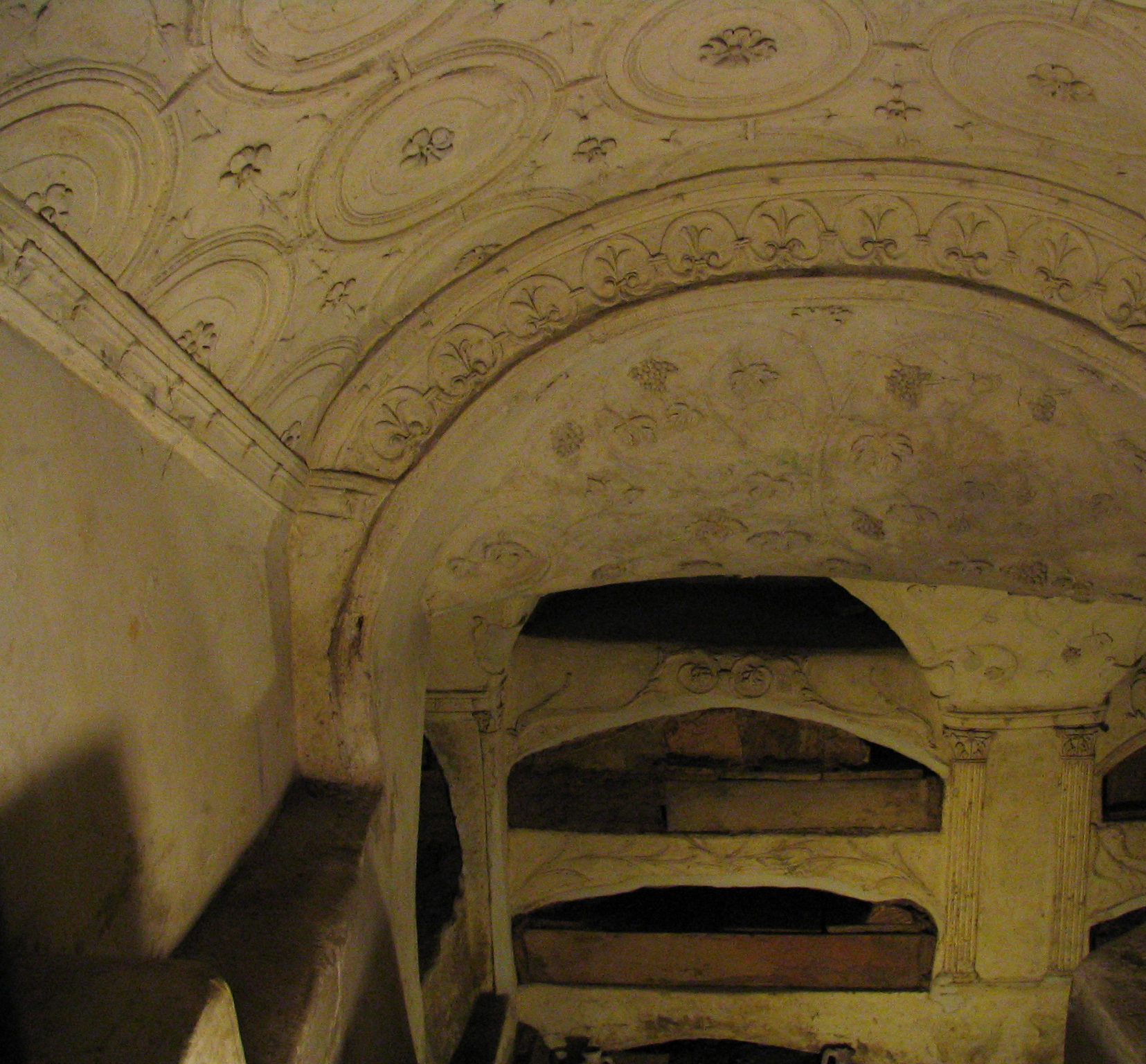
The Catacombs of San Sebastiano were excavated downward into approximately four layers (or levels) carved from the soft tuff rock, reaching depths of up to 13 meters. We could feel the temperature difference coming from 40°C (104°F) and down there was around 17 – 18°C (~ 64°F) – perfectly refreshing. This multi-story structure maximized the use of space, functioning as a vertical “city of the dead.” The layers show a clear transition: shallower levels contain early Pagan mausoleums, while deeper levels were primarily expanded by the later Christian community. We were allowed to access only two levels and the lower ones were locked up by the metal gates. We some bones still remain in there.,
Burial types reflected status and belief. Pagan Romans used decorative urns for cremation and niche tombs in family mausoleums. Early Christians rejected cremation, favoring burial in simple, stacked, rectangular niches called loculi, which were sealed with inscribed slabs. More elaborate burials included the arched recess known as the arcosolium or massive, carved sarcophagi reserved for the wealthy.
The catacombs were also used for the refrigerium, a central social custom where families and friends shared a funerary meal at the tomb of the deceased on their anniversary. This maintained communion with the departed. Special areas, such as the triclia beneath the basilica, were equipped with benches and water to accommodate these communal gatherings, which, for Christians, sometimes echoed the Eucharistic rite. I can only imagine the smell of rotting bodies and people fiesting nearby. The smell must have been really foul in those catacoms as it is quite difficult to make the air move around
In all fairness, the pagan mousuleums looked much more impressive and more decorated than the Christian ones. Unfrotunately, we were not alowed to take pictures there either. I wonder why Vatican cares about Pagans burrials too?




The Basilica of San Sebastiano
The Basilica of San Sebastiano fuori le Mura (Basilica of St Sebastian Outside the Walls) is a historically profound site along the Via Appia Antica, serving as one of Rome’s original pilgrim churches. The importance of the site lies in the incredible subterranean burial grounds beneath it: the Catacombs of San Sebastiano. These catacombs offer a rare look at the fluid religious landscape of the early Roman Empire, as they were originally established over abandoned quarries and started as a Roman necropolis. Inside the burial chambers, a unique blend of practices can still be observed, with Pagan mausoleums and cremation urns often existing alongside Christian body burials, sometimes even within the same family tombs.


This sacred ground has strong ties to the earliest days of Christianity. Before its dedication to the martyr Saint Sebastian, who was buried here around 288 AD, the church was known as the Basilica Apostolorum. Tradition holds that the bodies of Saints Peter and Paul were temporarily hidden here during a period of persecution in the 3rd century, turning the site into a critical pilgrimage destination. Evidence of this veneration is seen in ancient graffiti left by faithful visitors beneath the church. Furthermore, the very term “catacomb” originated here, first applied specifically to this location before it was generalized to describe all underground Christian cemeteries.
Today, the basilica and its catacombs stand as a testament to this merging of worlds. The structure above ground preserves relics, including those of Saint Sebastian and, most notably, the original marble slab bearing the footprints believed to have been left by Jesus during the Domine Quo Vadis encounter. This exceptional site vividly demonstrates where the foundations of the ancient Pagan world met the emerging core of the Christian faith.
The powerful marble statue of Saint Sebastian (1671–1672) by Giuseppe Giorgetti in the Basilica of San Sebastiano fuori le Mura depicts dramatical fate of the saint in a state of laying down after being shot by arrows, retaining the ideal beauty of his youth even facing death. This Baroque work, executed for Cardinal Francesco Barberini, utilizes the brilliant white marble stone to emphasize the pale, idealized flesh of the suffering figure, drawing on the tradition of representing the saint as an ephebe—a beautiful, young male figure. The sculpture illustrates the first part of the legend of Saint Sebastian, who was a 3rd-century Roman soldier and secret Christian. When his faith was discovered by Emperor Diocletian, he was condemned to be tied to a post and executed by archers’ arrows. However, according to the legend, the arrows miraculously failed to kill him, and he was later found and nursed back to health by the widow Irene of Rome, only to be clubbed to death upon defiantly confronting the Emperor for a second time.


Bernini’s Final Masterpiece: Bust of the Saviour (Salvator Mundi)
The moment you enter the basilica you will notice an exceptional sculpture. That is a masterpiece by a famous Italian sculptor Giovan Lorenzo Bernini.
The sculpture was created his private devotion and was intended as a bequest for Queen Christina of Sweden. This last work was already considered the spiritual and artistic testament of the great Baroque master by 17th-century art literature.
The piece disappeared but was found in 2001 in the convent annexed to the Basilica of San Sebastiano fuori le mura. After its authenticity was verified and it was restored in 2006, it was transferred to its current display location beneath the Borghese coat of arms in the basilica.
The work was designed to be larger than life and was conceived for a view from below, utilizing a pyramidal shape to accentuate its size. A distinctive finish was employed on the marble, characterized by chiaroscuro and luminosity. The rendering of the coat’s folds, hair, and features was executed in an abstract style, moving beyond strict naturalistic demands.


I was thirsty after leaving the catacombs as it was really hot outside. Once again I saw nasone and used the cold water to satisfy my thirst, by trapping a bigger hole and letting water to flow through the smaller one. It was cold and really refreshing and I filled up my bottle with it.


Ride Back On A Busy Bus
We had to wait for the bus in the bus stop for a really long time. I was even considering calling uber as it was getting quite late. One bus that was supposed to come didn’t come at all, so the next one was in 30min. So in total we had to wait around 45 min. The bus stop really filled up with people and a big group of nuns and priests. There was a mystery chair nearby. I was so tempted to sit down on it after so long standing. Actually no one sat down in it. The bus stop is literally on the road and not much space even to sit on the ground.


The bus finally arrived and everyone rushed inside. Even the nuns were trying to cut in front and squeeze in. Everyone somehow fit into the bus, but we were really squeezed. I was just watching my bag not to get pick-pocketed, but behind me was only nuns, so I assumed it must be safe to position my bags towards them.

Beautiful Sunset Spot in Rome
In the evening we went to Scalinata dell’Ara Coeli and climbed to the top of the stairs. It was quite busy at the top and finding a spot on the stairs was quite difficult. So do come early! We opened a bottle of red wine and poured it into our plastic cups and enjoyed the view with Sun hiding behind the buildings of Rome and painting the city into dark red and orange colour mix.


Other Catacombs to See in Rome
Other catacombs you can visit nearby Basilica of St Sebastian are Catacombe Domitilla and Catacombe di San Callisto, which contains more bones and skulls. However, at the time of our visit they were closed, so it was an easy choice.


Places Not To Miss
Arch of Drusus is a single archway, often mistaken for a part of the adjacent Porta San Sebastiano. It’s an important remnant of the ancient Aqua Marcia aqueduct, which was integrated into the city’s walls and gates. A great visual history lesson on Roman engineering adaptation.
Visit inside of Porta San Sebastiano – The largest and best-preserved gate in the Aurelian Walls, now housing the Museum of the Walls (Museo delle Mura). You can climb the ramparts for a unique view of the Appian Way (Via Appia Antica). The interior mosaics and structure illustrate the defensive ingenuity of ancient Rome.
Porta Latina is historical significance relates to the “Miracle of the Oil” legend of St. John the Evangelist. It offers a picturesque, less-crowded stop along the walls, connecting to ancient roads. It is a smaller, well-preserved gate near Porta San Sebastiano.